
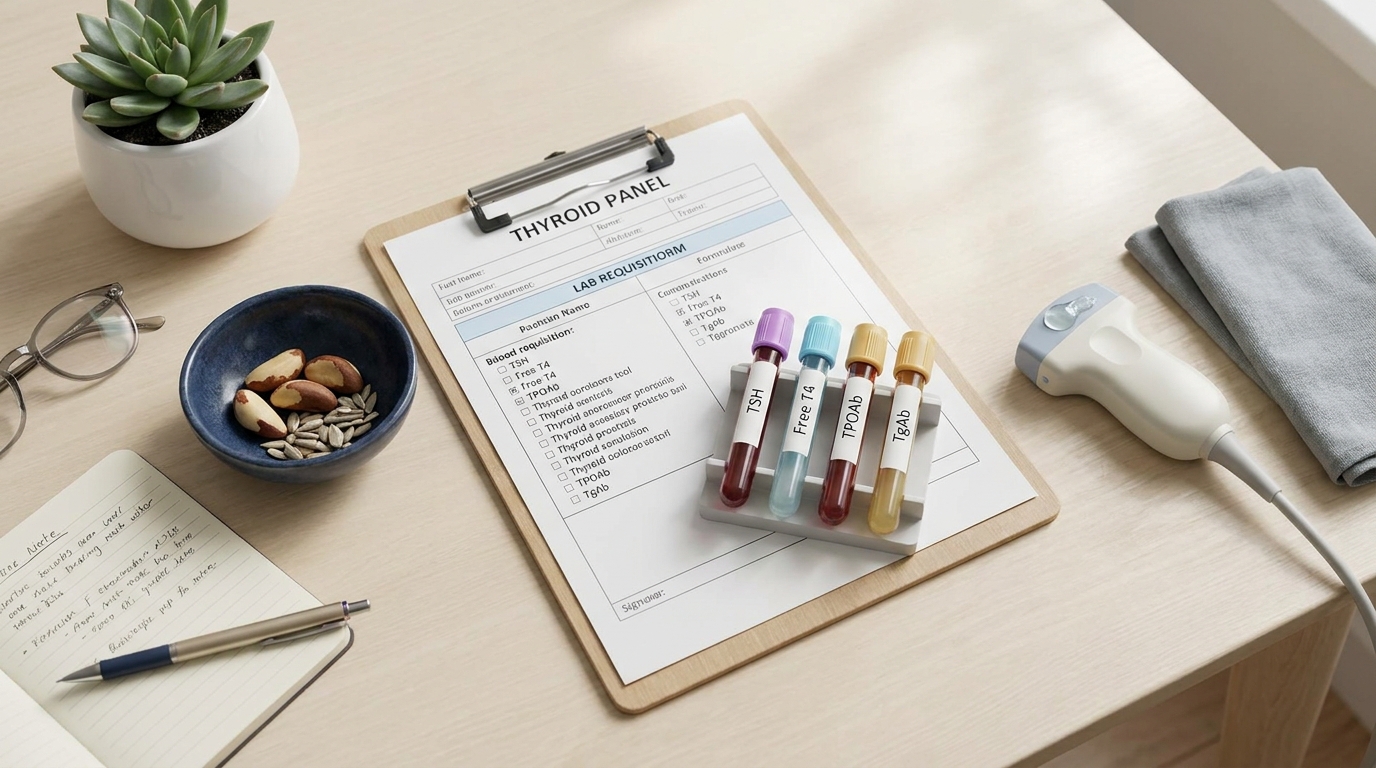
Your TSH comes back "normal" for the third time this year, but the fatigue, the hair falling out in the shower drain, the cold hands, the weight that won't move — none of that has changed. That gap between a normal TSH and a body that's clearly struggling is exactly where Hashimoto's thyroiditis testing needs to go deeper than a single number.
- TSH alone misses most Hashimoto's thyroiditis testing cases — Buy the full panel (TSH, Free T3, Free T4, TPO, TgAb) over a TSH-only screen.
- Thyroid antibody testing (TPO and TgAb) is the only way to confirm autoimmune thyroiditis, not just low thyroid function.
- A self-order TSH-only test is a Skip for anyone with symptoms and a family history of thyroid disease.
- Nutrient and gut markers tied to autoimmunity round out a 2026-standard functional medicine workup — Consider adding them if antibodies are positive.
Why this matters
Hashimoto's thyroiditis is an autoimmune condition — the immune system attacks the thyroid gland, and TSH often stays inside the "normal" reference range for years while antibodies climb and symptoms build. A standard primary care visit typically orders TSH and stops there. That's screening for thyroid function, not thyroid autoimmunity, and it's why so many women get told their labs are fine while they feel worse every month.
The distinction matters because treatment approach changes once autoimmunity is confirmed. A functional medicine workup for Hashimoto's thyroiditis testing in 2026 typically layers antibody testing, full thyroid panels, and inflammation and nutrient markers on top of TSH — because thyroid antibodies can be elevated for years before TSH moves out of range.
Who this is for
This guide is for women who've had a TSH test come back "normal" while dealing with fatigue, unexplained weight gain, hair thinning, brain fog, cold intolerance, or irregular cycles — especially with a family history of thyroid or autoimmune disease. It's also for anyone already diagnosed with hypothyroidism on levothyroxine whose symptoms haven't resolved despite a "normal" TSH on follow-up labs. If that's you, the question isn't whether your thyroid is a little off — it's whether the testing you've had so far was ever designed to catch autoimmune thyroiditis in the first place.
What to look for in Hashimoto's thyroiditis testing
Full thyroid antibody panel, not just TSH
TPO antibodies (thyroid peroxidase antibodies) and thyroglobulin antibodies (TgAb) are what actually confirm Hashimoto's. A TSH-only test can sit inside a "normal" range for years while antibodies are already elevated and actively damaging thyroid tissue. Skip any workup that never orders antibodies — it can't diagnose the autoimmune process even if it's happening.
Free T3 and Free T4, measured directly
TSH is a pituitary signal, not a direct measure of the thyroid hormone reaching your cells. Free T3 is the active hormone your tissues actually use, and low Free T3 with a "normal" TSH is one of the most common patterns in undiagnosed Hashimoto's. A panel that reports only TSH can't show this pattern at all.
Reverse T3
Reverse T3 is an inactive form of thyroid hormone that competes with Free T3 at the cellular level. Elevated Reverse T3 shows up during chronic stress, illness, or inflammation, and it explains why some patients feel hypothyroid despite lab values that look acceptable on paper. It's a marker most conventional panels skip entirely.
Thyroid ultrasound
An ultrasound shows structural changes — nodules, gland texture, size — that blood work alone can't detect. Hashimoto's often produces a characteristic "heterogeneous" texture on imaging even before antibody levels are dramatically high. It's a low-cost add-on that turns a lab-only workup into a full clinical picture.
Nutrient markers tied to thyroid autoimmunity
Selenium, ferritin, vitamin D, and zinc all influence thyroid hormone conversion and immune regulation. Low ferritin in particular is common in women with Hashimoto's and often gets missed because a standard CBC doesn't flag it as a thyroid-relevant marker. Correcting these deficiencies is frequently part of a 12-week protocol built around lab results, not a standalone fix.
Gut and inflammation markers
Hashimoto's is strongly linked to intestinal permeability and gut dysfunction, including SIBO. A workup that stops at the thyroid and ignores gut markers misses one of the more common root-cause drivers behind ongoing antibody elevation. This is where a functional medicine approach diverges most from a standard endocrinology visit.
Ranked: testing options for Hashimoto's thyroiditis
TSH-only screening (primary care standard). The number one thing to know: this test alone cannot diagnose Hashimoto's thyroiditis. It measures pituitary signaling, not autoimmune activity or active hormone levels, and it's the reason most women get told their labs are "normal" for years before a diagnosis lands. Verdict: Skip as a standalone workup if you have symptoms and a family history.
Standard panel: TSH plus TPO antibodies. This adds the single most useful marker for confirming autoimmune thyroiditis and is a meaningful step up from TSH alone. It still misses Free T3, Reverse T3, and TgAb, so a positive result here should trigger a fuller panel rather than end the workup. Verdict: Consider as a starting point, not a finish line.
Comprehensive panel: TSH, Free T3, Free T4, TPO, TgAb, Reverse T3, plus nutrient markers. This is the level of Hashimoto's thyroiditis testing built into a root-cause functional medicine workup, and it's the version that actually explains why symptoms persist when TSH looks fine. Naturamed builds protocols around this full panel for women in Maitland/Orlando and via telemedicine across Florida, Michigan, and Texas. Verdict: Buy — this is the panel that changes what happens next.
Self-order direct-to-consumer lab test with no clinician interpretation. Ordering your own labs online gets you the numbers but not the context — a Free T3 at the bottom of the reference range or a mildly elevated TgAb needs a clinician who treats thyroid autoimmunity to interpret it correctly. Useful for tracking trends over time, weak on its own for diagnosis. Verdict: Consider only as a supplement to clinical care, never a replacement.
General endocrinology referral without functional workup. Many endocrinologists manage Hashimoto's well once TSH is abnormal, but visit time is often short and gut, nutrient, and lifestyle drivers rarely make it into a 15-minute follow-up. Good for medication management once diagnosed, limited for finding why antibodies are elevated in the first place. Verdict: Consider as a complement to root-cause testing, not a substitute.
Get a full Hashimoto's workup
Root-cause thyroid and antibody testing, in Orlando or by telemedicine in FL, MI, TX.
What to avoid
- TSH-only panels marketed as "complete thyroid testing." If antibodies aren't on the requisition, it's a function test, not an autoimmune test.
- Chasing a single "normal" antibody result and stopping. TPO antibodies can fluctuate; a single low reading doesn't rule out Hashimoto's, especially with ongoing symptoms.
- Treating fatigue and weight gain as separate issues from thyroid labs. In autoimmune thyroiditis, gut inflammation, nutrient depletion, and thyroid symptoms are frequently connected, and testing them in isolation misses the pattern.
Verdict comparison
| Testing option | Confirms autoimmunity | Measures active hormone (FT3) | Clinician interpretation | Verdict |
|---|---|---|---|---|
| TSH-only screening | No | No | Yes | Skip |
| TSH + TPO antibodies | Yes (partial) | No | Yes | Consider |
| Comprehensive panel (TSH, FT3, FT4, TPO, TgAb, RT3, nutrients) | Yes | Yes | Yes | Buy |
| Self-order DTC lab test | Depends on panel | Depends on panel | No | Consider |
| General endocrinology referral | Yes, post-diagnosis | Sometimes | Yes | Consider |
FAQ
What is the best test for Hashimoto's thyroiditis?
The most reliable Hashimoto's thyroiditis testing combines TSH, Free T3, Free T4, and thyroid antibodies (TPO and TgAb). TSH alone cannot confirm autoimmune thyroiditis because it can stay in range for years while antibodies are already elevated.
Can you have Hashimoto's with normal TSH?
Yes, TSH can stay within the standard reference range while TPO or TgAb antibodies are elevated and Free T3 is low. This is one of the most common reasons women get told their labs are normal despite ongoing symptoms.
Is Hashimoto's thyroiditis testing covered without a diagnosis yet?
Coverage depends on your insurance plan and the ordering clinician's documentation of symptoms; antibody panels are a standard diagnostic step, not an experimental test, so most plans process them like any other lab order. Check your specific plan before scheduling.
How often should thyroid antibodies be retested?
Most functional medicine protocols retest antibodies and full thyroid panels every 3 to 6 months while adjusting a treatment plan, then space out testing once levels stabilize. Retesting too soon after starting a protocol rarely shows meaningful change.
What's the difference between TPO antibodies and TgAb?
TPO antibodies target thyroid peroxidase, an enzyme involved in hormone production, while TgAb targets thyroglobulin, a protein the thyroid uses to make hormone. Either can be elevated in Hashimoto's, and testing both catches more cases than testing one alone.
Does gut health affect Hashimoto's thyroiditis testing results?
Gut inflammation and conditions like SIBO are linked to higher thyroid antibody levels in some patients, which is why a root-cause workup often adds gut and inflammation markers alongside thyroid labs. Addressing gut dysfunction is sometimes part of lowering antibody levels over time.
Can Hashimoto's thyroiditis be reversed?
Hashimoto's is a chronic autoimmune condition, but antibody levels and symptoms can improve significantly with a targeted protocol addressing nutrient deficiencies, gut health, and thyroid hormone replacement when needed. Improvement is typically measured over months, not weeks.
Should I see an endocrinologist or a functional medicine clinic for Hashimoto's?
Endocrinologists manage thyroid hormone replacement and monitor disease progression well once diagnosed; functional medicine clinics typically spend more time on root-cause factors like gut health, nutrient status, and lifestyle triggers. Many patients use both approaches together rather than choosing one.
One last thing
The detail that trips up the most patients: TPO antibodies can be positive for years before TSH ever moves out of the "normal" range, which means a diagnosis of Hashimoto's is possible well before conventional thyroid function tests would ever flag it. If your labs have been "normal" more than once but your body says otherwise, the antibody panel — not another TSH recheck — is the test that changes the answer.